

Lifting AGV Case Study: Automated Tray Transport for a Silkworm Production Facility

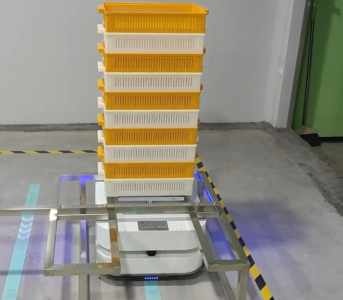
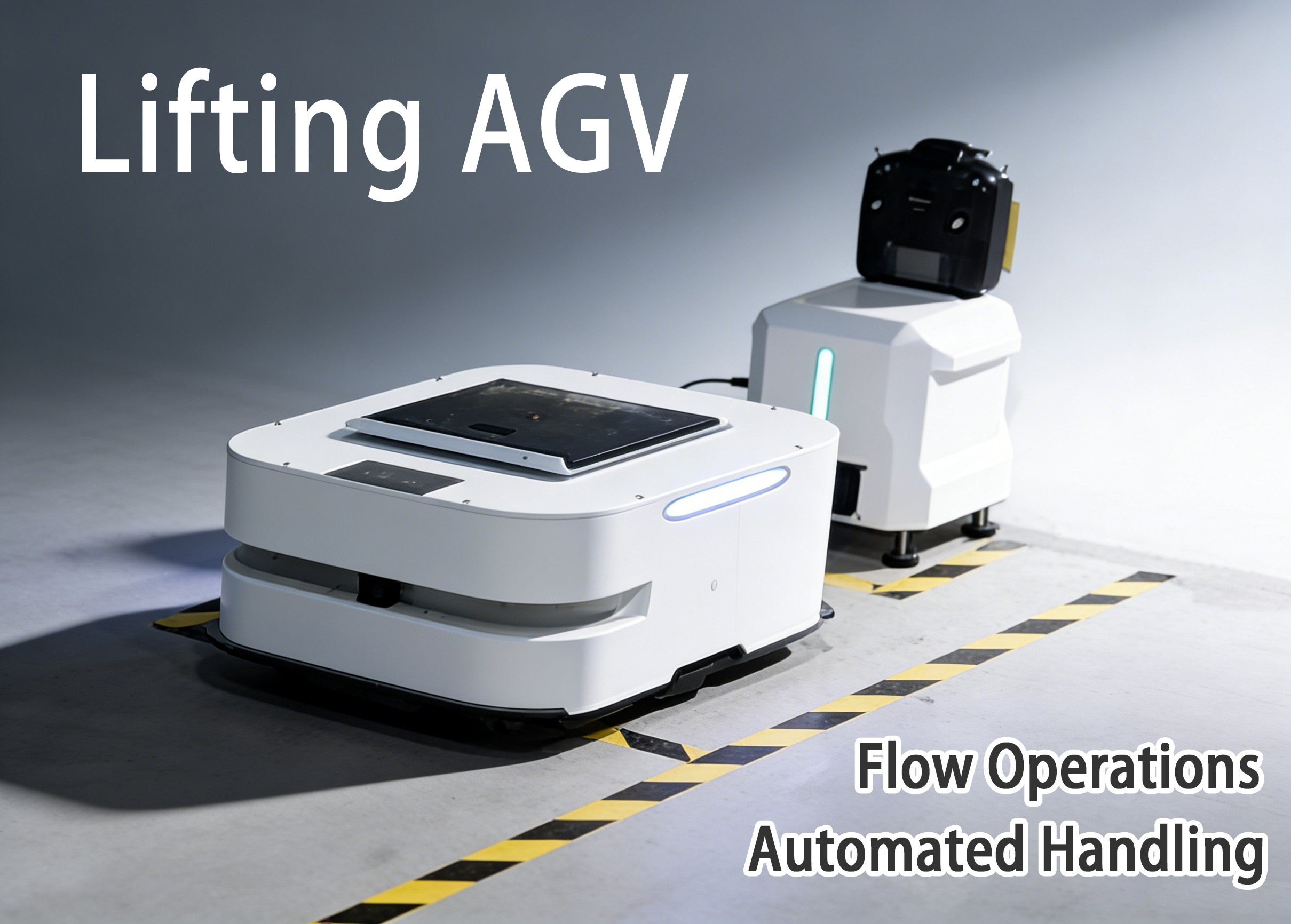
Material transport inside a specialized production facility is rarely as simple as moving a box from one point to another. The load may be tall, the floor layout may include fixed frames, and every pickup and drop-off position must match the process equipment. This lifting AGV application shows how a mobile robot can be adapted to move stacked production trays through a silkworm facility.
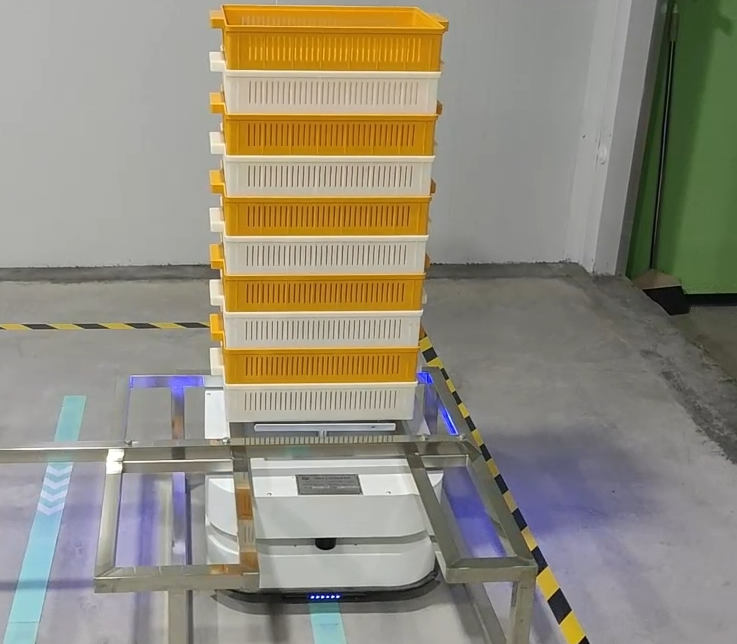
The project required more than a general-purpose mobile base. The robot had to travel beneath a dedicated metal carrier, lift a tall stack of ventilated trays and place the load accurately at the next workstation. The solution therefore combined autonomous navigation, a compact chassis and an integrated lifting mechanism.
The Material-Handling Challenge
Silkworm production uses multiple shallow trays that are commonly stacked for transfer between process areas. Moving these stacks manually creates several challenges:
- Tall loads can be awkward for operators to handle.
- Repetitive transfers consume labor that could be used for higher-value work.
- Uneven handling may disturb the stacked trays.
- Narrow routes and fixed production frames limit vehicle size.
- Pickup positions must be repeatable for reliable automated operation.
The robot also needed to approach a carrier frame without striking its structure. This made chassis dimensions, sensor placement and stopping accuracy important parts of the design.
HXROBOT Lifting AGV Solution
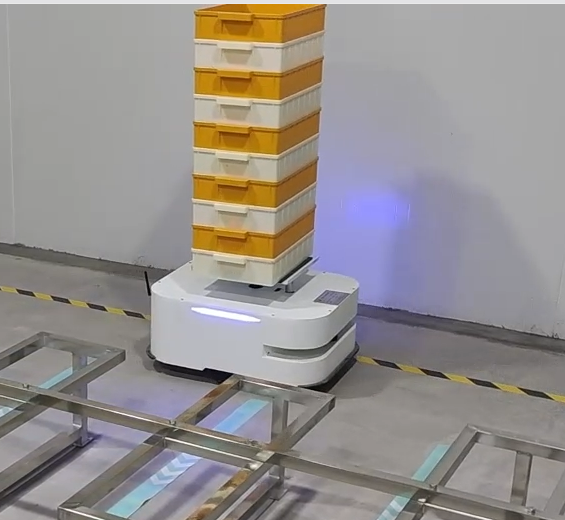
The customized platform uses a low-profile mobile base with a top lifting module. During operation, the AGV enters the carrier frame, aligns with the load, raises the stacked trays and transports them along the programmed route. At the destination, it positions itself at the receiving frame and lowers the load.
This under-load handling method keeps the robot footprint compact and avoids the long forks required by a conventional forklift-style vehicle. It is suitable for trays, shelves, racks and other loads that can be supported by a standardized carrier.
The solution can be configured with LiDAR-based navigation, obstacle detection, route management, workstation calling and automatic charging according to the facility layout. Mechanical dimensions and lifting stroke can also be adjusted for the customer’s carrier design.
How the Workflow Operates
- A transport request is created by an operator, workstation or production-management system.
- The AGV travels to the pickup point using the configured navigation method.
- Sensors help the platform align beneath the metal carrier.
- The lifting mechanism raises the stack from the support frame.
- The AGV transports the trays to the target workstation.
- The robot lowers the stack and leaves the receiving frame.
- It accepts the next task or returns to a charging location.
This sequence can be integrated into a larger production flow, allowing several pickup and delivery points to share the same mobile robot.
Key Engineering Considerations
Load Stability
A tall tray stack has a higher center of gravity than a flat pallet. Acceleration, deceleration and turning speed should therefore be configured conservatively. The lifting plate and carrier frame must also keep the load centered over the chassis.
Positioning and Docking
The robot must align accurately with the carrier before lifting. Mechanical guides, LiDAR, visual markers or other local positioning methods can be selected according to the required repeatability.
Route and Floor Conditions
The minimum aisle width, turning area, floor joints and slopes should be measured before the chassis is finalized. A site drawing helps determine whether differential drive, omnidirectional movement or another configuration is most suitable.
Safety
Obstacle-detection sensors, emergency-stop buttons, warning lights and configurable speed zones help the AGV operate around people and equipment. The final safety design should be based on the load, speed and production environment.
Where This Solution Can Be Reused
Although this project was designed around silkworm trays, the same lifting AGV concept can be adapted for:
- Food-production trays
- Textile-process racks
- Electronics material carts
- Warehouse shelves
- Laboratory sample carriers
- Agricultural seedling trays
- Work-in-process transfer between assembly stations
The most important requirement is a standardized carrier that allows the robot to enter, lift and release the load safely.
Choosing a Customized Lifting AGV
To evaluate a similar project, provide the load weight, stack dimensions, carrier drawing, pickup height, lifting stroke, aisle width, route length, floor conditions and required number of transfers per hour. HXROBOT can use this information to recommend a chassis, lifting mechanism, navigation method and charging solution.
A successful lifting AGV project begins with the workflow rather than the robot specification. When the carrier, route and docking positions are designed as one system, autonomous tray transport can become a reliable part of daily production.